 blog
Plant Training Costs: What You'll Actually Spend
Table of Contents
- What Plant Training Costs Cover
- CPCS Training Course Duration and Pricing
- NPORS vs CPCS Cost Comparison
- Hidden Costs of Plant Operator Certification
- Factors That Influence Your Total Investment
- Breaking Down the Real Expenses Month by Month
- Making the Decision: Is the Investment Worth It?
- Frequently Asked Questions
Last Updated: October 4, 2026
What Plant Training Costs Cover
Plant training cost covers several distinct components. Understanding what you're actually paying for helps you budget properly and avoid surprises.
Your investment typically includes classroom instruction, practical hands-on training, assessment fees, and certification documentation. The course provider delivers theory sessions covering machinery operation, safety regulations, and site protocols. Practical training puts you in the operator's seat under supervision.
Assessment costs are separate from tuition at many providers. You'll pay to sit your test with an approved assessor. Certification documentation, your actual ticket or card, comes after you pass. Some providers bundle these into one price. Others charge à la carte.
What's often NOT included: travel to training locations, accommodation if you're training away from home, uniform or protective equipment, and refresher training after your initial qualification expires. Many trainees overlook these hidden costs until they're booking their course.
CPCS Training Course Duration and Pricing
CPCS (Construction Plant Competency Scheme) is the most common plant operator certification in the UK. The CPCS training course duration typically ranges from 3 to 5 days for a single plant type, depending on your prior experience and the machinery category.
If you're completely new to plant operation, expect the longer end of that range. Experienced machinery operators might complete a CPCS training course duration in fewer days because they already understand foundational safety principles and basic controls.
Most CPCS courses run as intensive blocks. You attend full days, typically 8 to 10 hours, to compress learning into a short timeframe. This suits people who need to get qualified quickly without taking extended unpaid leave.
The actual cost varies significantly based on machinery type and provider. Excavators, telehandlers, and dumpers have different CPCS training course duration requirements. Specialised equipment like mobile cranes takes longer and costs more. Plant training cost for basic machinery sits lower than premium certifications.
NPORS vs CPCS Cost Comparison
NPORS (National Plant Operators Registration Scheme) and CPCS are the two major certification routes in the UK. Both are industry-recognised, but they differ in cost structure and training approach.
NPORS vs CPCS cost comparison shows that NPORS training often takes longer, typically 5 to 7 days for a single plant type. Longer training means higher tuition fees. However, NPORS credentials last longer before renewal, which some operators see as better value over a career.
CPCS courses compress content into shorter blocks, making them cheaper upfront. You pay less per course but renew your card more frequently. Over a 10-year career, the total cost might balance out, but CPCS requires more ongoing investment.
The NPORS vs CPCS cost comparison also factors in assessment fees and card renewal costs. CPCS cards typically expire after 5 years. NPORS cards last longer, reducing how often you repeat expensive assessments.
Your choice often depends on your employer's preference. Many large construction firms prefer CPCS because the shorter training duration means less downtime. Smaller operations or specialist contractors might favour NPORS. Check what your target employers actually require before committing to either route.
Hidden Costs of Plant Operator Certification
Plant training cost extends far beyond tuition fees. Most trainees discover unexpected expenses after they've enrolled.
Travel and accommodation top the hidden costs list. Training centres aren't always local. You might travel 50+ miles to the nearest approved provider. Daily petrol costs add up quickly over a 5-day course. If the centre is too far for daily commuting, you're paying for accommodation, hotels, B&Bs, or short-term rentals.
Protective equipment and workwear come next. You need steel toe-cap boots, high-visibility clothing, a hard hat, and safety gloves. Most training providers won't let you on site without proper kit. Some providers sell this equipment onsite at inflated prices. Buying beforehand from a workwear supplier costs less.
Medical checks and documentation are often required before you start. An occupational health assessment might be mandatory. Vision tests for certain machinery categories are compulsory. These aren't expensive individually but stack up.
Refresher training kicks in after your certification expires. CPCS cards last 5 years. You'll need to retrain and reassess to keep working. Budget for this recurring cost throughout your career.
Course materials sometimes aren't included. Manuals, study guides, or online access might cost extra. Some providers bundle these. Others charge separately.
Many trainees spend 20-30% more than their quoted course fee once they account for everything. Factor in these hidden costs when deciding whether to pursue plant training cost investment.
Factors That Influence Your Total Investment
Several variables directly impact how much you'll spend on plant training cost.
Machinery type is the biggest cost driver. Basic machinery, dumpers, compactors, roller operators, costs less to train for. Specialist equipment like mobile cranes, telehandlers, or slewing cranes demands higher fees because instructors need advanced qualifications and equipment access is more expensive.
Your starting experience matters significantly. If you've already operated one type of plant, training for a second type costs less and takes fewer days. Complete beginners pay full price and attend full-length courses.
Geographic location affects pricing. Training centres in major cities typically charge more than rural providers. London and the South East have higher fees than regions with lower cost of living. However, rural trainees often pay more in travel costs, offsetting any savings.
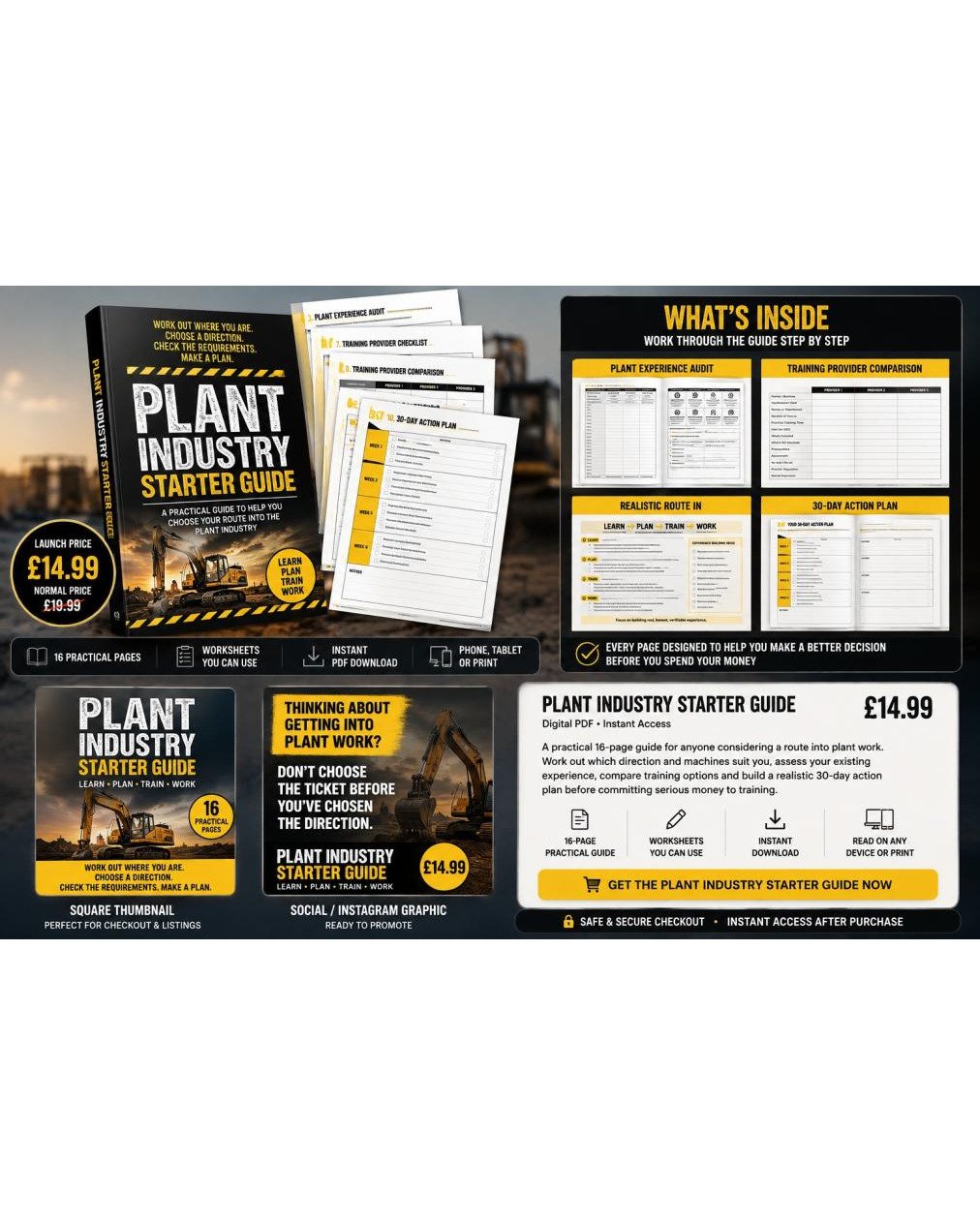
Get the Plant Industry Starter Guide →
Provider reputation and accreditation influence fees. Established training companies with excellent pass rates charge premium prices. Budget providers might be cheaper but have lower pass rates, meaning you could fail and need to retrain, a hidden cost.
Course timing impacts plant training cost. Peak season (spring through summer) sees higher prices and longer waiting lists. Winter courses often cost less because demand drops. However, winter weather can disrupt practical training.
Bundled vs. modular training changes your total spend. Some providers offer package deals covering multiple plant types at a discount. If you only need one certification, bundled pricing wastes money. If you need three, bundling saves significantly.
Assessment attempts matter if you fail. Most fees cover one attempt. Retesting costs extra. Providers with thorough training have higher pass rates, reducing this risk.
Breaking Down the Real Expenses Month by Month
Let's walk through realistic monthly costs for someone pursuing plant training cost investment from start to employment.
Month 1: Research and preparation. You're investigating courses, comparing providers, and gathering documents. Expect minimal costs here, maybe petrol for site visits or phone calls. Budget: £0-50.
Month 2: Course enrolment and deposits. You book your CPCS or NPORS training course duration. Many providers require a deposit to secure your place. This might be 25-50% of the course fee. You also start buying workwear and safety equipment. Budget: £400-800.
Month 3: Course delivery and accommodation. Your training week arrives. You pay the balance of tuition fees, accommodation costs if needed, and daily travel expenses. This is your biggest single month. Budget: £1,200-2,000.
Month 4: Assessment and certification. After your course ends, you sit your formal assessment. Assessment fees aren't always included in course tuition. You pay for your certification card or CPCS ticket. Budget: £200-400.
Month 5: Job hunting and transition. You're now qualified but job-hunting. No training costs, but you might have travel expenses attending interviews or site inductions. Budget: £100-300.
Month 6: First employment. You're working as a plant operator. Training costs end here. Your salary now covers living expenses.
Total investment over 6 months: roughly £1,900-3,550 depending on machinery type, location, and provider choice.
This timeline assumes smooth progress. If you fail your assessment and retrain, add another £1,000-1,500 and 2-3 months to the timeline.
Making the Decision: Is the Investment Worth It?
Plant training cost investment makes sense if you're serious about a plant machinery career. The qualification opens doors that don't exist without it. Most operators earn solid wages once they're established, making the initial investment recoverable within 12-18 months of employment.
However, this investment only pays off if you actually secure work afterwards. The catch-22 is real: employers want experience, but you need a job to gain experience. This is where realistic preparation matters. Understanding what the job actually involves, the physical demands, the site conditions, the pressure, helps you decide before spending thousands.
Our guides go beyond just explaining plant training cost. We cover what the work is actually like, where jobs are, realistic salary expectations, and whether this career suits your circumstances. Too many people invest in training, then discover the job isn't for them.
The investment is worthwhile if:
- You've researched the actual working conditions
- You understand realistic entry-level salaries
- You've confirmed local job demand
- You're physically capable of the work
- You can afford the upfront cost without derailing other financial goals
The investment is risky if:
- You're training just because it sounds like quick money
- You haven't confirmed job availability in your area
- You're uncertain whether you can handle physical, outdoor work
- You can't afford to be unemployed for 2-3 months after qualifying
- You're using borrowed money that creates pressure to take unsuitable jobs
Plant training cost is an investment, not a guarantee. Make it with eyes open.
Entering the plant machinery industry requires upfront investment, but the path is clearer than many people realise. Plant training cost varies widely, but understanding what drives those costs helps you budget realistically and avoid surprises. The Plant Industry Starter Guide breaks down not just the training expenses, but the actual working conditions, job prospects, and career realities you'll face. Before you commit thousands to a course, make sure you're investing in something that genuinely fits your circumstances. Get the Plant Industry Starter Guide and approach this decision with complete information rather than assumptions.
Frequently Asked Questions
How much does a CPCS card cost to obtain?
CPCS card costs vary depending on the machine category and training provider. The card itself is issued by CPCS after you pass your test, but the main expense is the training course leading up to it. Costs typically include the course fee, the CPCS test fee, and your medical examination. For accurate current pricing, contact your chosen training provider directly, as fees change regularly and depend on your specific machinery category.
What hidden costs should I budget for when training for plant operation?
Beyond course fees, budget for medical and health and safety tests, travel to training locations, work clothing and boots, and potentially accommodation if training is distant from home. Some trainees also pay for refresher training or additional certifications after their initial qualification. Insurance and ongoing professional development may add further costs. These hidden expenses can easily total £500 to £1,500 depending on your circumstances.
Is plant operator training more expensive than HGV training?
Plant training and HGV training operate on different cost structures. Both require substantial investment in practical training and testing, but the specific costs depend on the certification body (CPCS or NPORS for plant, DVLA for HGV), the specific machinery or vehicle category, and your training provider. Direct comparison is difficult without checking current pricing from providers, but both typically represent significant upfront investment for career changers.
Are there government-funded plant operator training courses available?
Funding availability changes regularly and depends on your circumstances, age, and employment status. Some apprenticeship schemes include plant training components with employer or government support. Check with your local authority, Jobcentre Plus, or training providers about current schemes. Many career changers find they must self-fund their initial training, though some employers offer support once you're hired.