 how-to
7 Signs Plant Machinery Work Is Right for You
Last Updated: 30 October 2026
Quick Summary
Plant machinery work suits you if you like practical problems, can concentrate for long stretches, are comfortable outdoors in all weather, take rules seriously, can work alone without drifting, have basic maths skills and want a skill that travels. If four or more of these signs sound like you, the work is worth exploring properly.
- Score each line of the self-assessment checklist from 1 to 5; a total of 35 or more suggests the work fits you well.
- Expect vibration, noise and long periods seated in awkward positions, with aches in the shoulders and lower back over time.
- A 7am start often means leaving home at 5:30am, and night and weekend work are common on infrastructure projects.
- Most people enter through a training course followed by a competence card, then start as a trainee or labourer while building hours.
- Under PUWER, equipment must be suitable, maintained and used by trained people, so you carry out pre-use checks and report defects.
Table of Contents
- What Plant Machinery Work Actually Involves Day to Day
- 7 Signs Plant Machinery Work Suits You
- The Physical Demands and Working Conditions to Expect
- Construction Job Salary Expectations and Regional Variation
- Plant Operator Training Duration and Entry Routes
- CPCS Card Requirements and Health and Safety Responsibilities
- Get the Plant Industry Starter Guide Before You Book a Course
- Frequently Asked Questions
What Plant Machinery Work Actually Involves Day to Day
Plant machinery work is the operation of heavy construction equipment such as excavators, telehandlers and mini excavators on sites, quarries and industrial yards.
A typical shift starts early. You arrive, sign in, and walk the machine before touching the controls. You check oil, coolant, tracks, hoses and mirrors.
Then the work begins. Digging trenches. Lifting materials. Moving spoil. Loading wagons. Most of the day is spent in the cab, but not all of it.
It is hands-on work with real responsibility. One wrong swing of the arm can damage services, injure someone, or stop the whole site. That pressure is constant.
7 Signs Plant Machinery Work Suits You
Not everyone takes to plant machinery work. The people who stick with it tend to share a handful of traits, and the people who leave early usually cite the same few mismatches. Here are the seven signs that matter most, based on what we hear from operators who make the switch successfully.
- You like practical problems. A trench floods, a load shifts, a machine won't start. You enjoy working out why rather than waiting for someone else to fix it.
- You can concentrate for long stretches. Operating machinery is repetitive and precise. Losing focus for ten seconds is how accidents happen, and the consequences are rarely minor.
- You are comfortable outdoors in all weather. Rain, cold, dust and mud are part of the job, not an occasional inconvenience. Sites rarely pause for weather.
- You take rules seriously. Health and safety is not paperwork here. It keeps people alive, and a good operator is the person who spots the unsafe lift before it happens.
- You can work alone without drifting. Many shifts involve long periods with little supervision. Self-motivation matters more than most people expect.
- You have basic maths skills. Levels, depths, gradients and load weights all involve numbers. You do not need to be a mathematician, but you do need to be comfortable with measurements and percentages.
- You want to build a skill that travels. A competent operator can work across sites, sectors and eventually self-employment. That portability is one of the job's quiet advantages.
If four or more of these sound like you, the work is worth exploring properly. If none of them do, no amount of training will make the job feel right.
The Practical Self-Assessment Checklist
Use this checklist honestly. Score each line from 1 (not me) to 5 (very much me). The point is not to pass or fail, but to see where your gaps are and whether they are gaps you can live with.
- I am happy starting early, often before 7am
- I can stay alert through repetitive tasks
- I do not mind getting dirty
- I am confident working at height or near excavations
- I can follow instructions precisely
- I am willing to study for a theory test
- I can handle being watched while I work
- I want a practical skill rather than a desk role
- I can cope with travelling to different sites
- I am comfortable with shift patterns that change
A total of 35 or more suggests the work fits you well. Between 25 and 34, look at which lines scored lowest and ask whether those are deal-breakers or things you can adapt to. Below 25, think carefully. There is no shame in either answer, and finding out now is cheaper than finding out after paying for a course.
Questions to Ask Before You Commit
A checklist only goes so far. Before you book training, ask yourself these questions, and if you can, ask an experienced operator the same ones:
- Would I rather be outside in February than in an office?
- Can I handle being the person responsible when something goes wrong?
- Am I willing to spend my own money on training before I earn anything?
- Do I want a job that is physical but not necessarily athletic?
- Can I accept that the first year may involve labouring and watching before operating?
If you cannot answer those honestly, you are not ready to commit. If you can, you are in a much better position than most people who book a course on impulse.
The seven signs the article says matter most when deciding whether plant machinery work suits you.
| Sign | What it looks like |
|---|---|
| Likes practical problems | Works out why a trench floods or a machine won't start |
| Can concentrate for long stretches | Stays precise through repetitive work; ten seconds lost focus causes accidents |
| Comfortable outdoors in all weather | Rain, cold, dust and mud are part of the job |
| Takes rules seriously | Spots the unsafe lift before it happens |
| Can work alone without drifting | Long shifts with little supervision; self-motivation matters |
| Has basic maths skills | Comfortable with levels, depths, gradients, load weights and percentages |
| Wants a skill that travels | Can work across sites, sectors and eventually self-employment |
The Physical Demands and Working Conditions to Expect
The physical side catches people out. You are not lifting bags of cement all day, but the cab is not a comfortable office either. The demands are cumulative rather than dramatic, and that is exactly why they are easy to underestimate.
Expect vibration, noise and long periods seated in awkward positions. Climbing in and out of machines repeatedly strains knees and backs. Many operators develop aches in the shoulders and lower back over time.
Conditions vary by site. Some days you work in a clean yard. Others you are in deep mud, dust or freezing wind.
A Realistic Day in the Life
A typical shift starts before the site is busy. You arrive, sign in, and walk the machine before touching the controls. You check oil, coolant, tracks, hoses and mirrors. Any defect gets reported, not ignored.
Then the work begins. Digging trenches. Lifting materials. Moving spoil. Loading wagons. Most of the day is spent in the cab, but not all of it.
It is hands-on work with real responsibility. One wrong swing of the arm can damage services, injure someone or stop the whole site.
Lifestyle Trade-offs Nobody Warns You About
The working conditions are only half the story. The lifestyle around them matters just as much for career fit.
Get the Plant Industry Starter Guide →
- Travel between sites. You may work an hour from home one month and two hours away the next. Some roles involve staying away during the week.
- Early starts. A 7am start often means leaving home at 5:30am, and that is before traffic.
- Shift patterns. Night work and weekend work are common on infrastructure projects, and they pay more for a reason.
- Isolation. Long periods alone in a cab suit some people and wear down others.
- Weather. You will work in conditions you would not choose for a hobby.
Accessibility and Reasonable Adjustments
Plant machinery work is physical, but it is not closed to people with common health conditions. Employers have duties under the Equality Act 2010 to make reasonable adjustments. Some roles are harder to adapt than others, so a conversation with an employer before applying can be useful.
Construction Job Salary Expectations and Regional Variation
Pay is the question everyone asks first, and the honest answer is that construction job salary expectations vary widely. Rates depend on the machine, the sector, your tickets, and where you work.
Newly qualified operators usually start on the lower end. Experienced operators on larger machines generally earn more.
Regional variation is real. Pay can vary by region, so check local rates for the work you are considering.
Plant Operator Training Duration and Entry Routes
Most people enter through a training course followed by a competence card. Plant operator training duration depends on the route you choose and the machines you want to cover.
A common path looks like this:
- Choose the machine category you want to operate
- Book training with an accredited provider
- Complete the theory and practical assessments
- Apply for your competence card
- Start as a trainee or labourer while building hours
Some people enter straight from school, while others retrain later in life.
CPCS Card Requirements and Health and Safety Responsibilities
The CPCS card requirements generally involve passing the relevant theory and practical tests for your machine category, then applying for the card through an approved test centre. If the theory test is the part you are unsure about, this step-by-step guide to passing the CPCS theory test walks you through it.
Health and safety responsibilities sit on your shoulders as much as anyone's. Under the Provision and Use of Work Equipment Regulations (PUWER), equipment must be suitable, maintained and used by trained people (Provision and Use of Work Equipment Regulations 1998 (PUWER) - overview).
Skipping pre-use checks is a common cause of preventable incidents on site. A short check protects you and everyone around you.
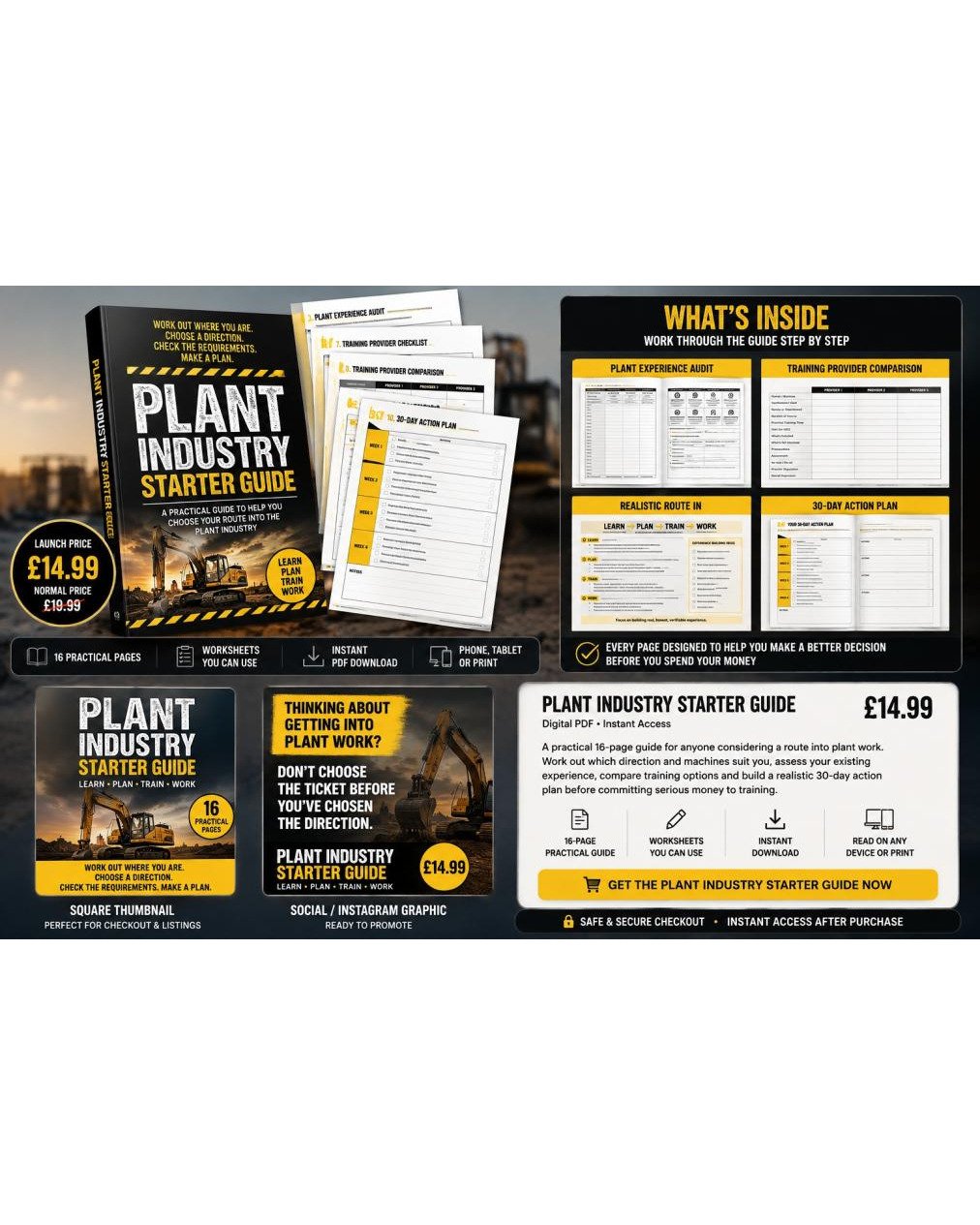
Get the Plant Industry Starter Guide Before You Book a Course
Here is the challenge: training costs money, and most people book a course before they know whether the work suits them. That is backwards.
Our guides exist to fix that. Plant Route UK draws on more than 30 years of hands-on experience in the plant and HGV industries. We cover training routes, licences, machinery types, working conditions and realistic career options, so you can decide with your eyes open.
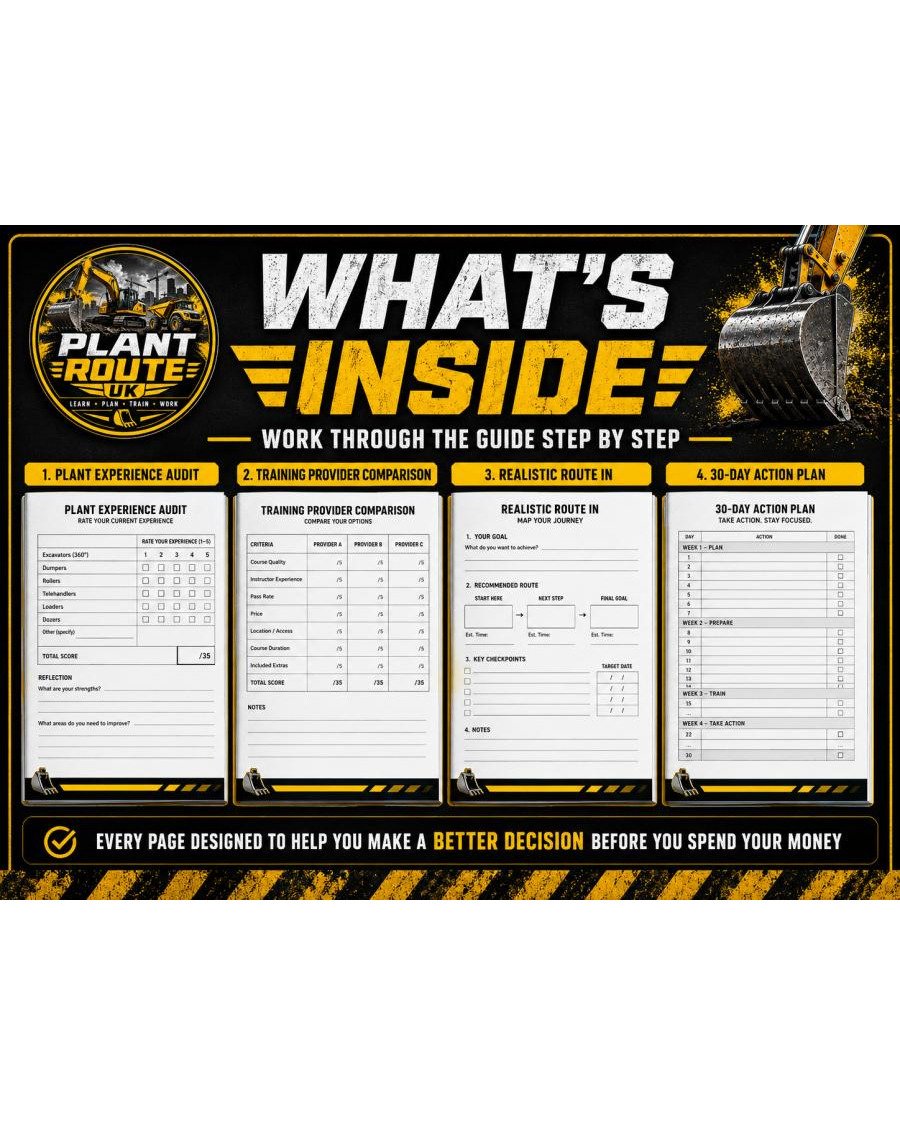
The guide covers training routes, licences, machinery types, working conditions and realistic career options.
Get started with the Plant Industry Starter Guide and make your decision with the full picture in front of you.
Frequently Asked Questions
What does a plant operator actually do on a daily basis?
A plant operator runs construction machinery such as excavators, mini excavators and telehandlers on site. A typical day starts with pre-use checks and a briefing, then digging, lifting, moving materials or grading ground to the site plan. You work closely with labourers, groundworkers and site managers, follow risk assessments, and keep the machine maintained. Hours vary by role and project.
How long does plant operator training usually take?
Plant operator training duration depends on the machine and your starting point. Courses vary in length depending on the category and provider. Experienced operators adding a category can complete shorter courses. After passing you still need to log working hours to move from a red to a blue CPCS card, so factor in that on-the-job period before you count yourself fully qualified.
What are the CPCS card requirements for a beginner?
To get a CPCS card you must pass the relevant CITB health, safety and environment test, then complete a CPCS technical test for the category you want to operate. Beginners usually start on the red trained operator card, which is valid for two years. Before it expires you need to achieve the relevant NVQ or SVQ to upgrade to the blue competent operator card. Always check current requirements with the awarding body before booking.
What are realistic construction job salary expectations for a new operator?
Pay varies with machine type, location and experience. Newly qualified operators typically earn less than experienced ones, and rates rise once you hold a blue competent operator card and can work unsupervised. Overtime, night work and larger sites push earnings higher. Ask local operators and agencies what rates they pay for the categories you plan to train in, because regional variation is significant and headline figures rarely reflect entry-level pay.
The plant industry rewards people who prepare. If you are ready to plan your route properly, start with our comprehensive plant machinery career guide and book your training only once you are sure.