 how-to
How to Get Plant Operator Jobs With No Experience
Last Updated: 2 November 2026
Quick Summary
Plant operator jobs with no experience are entry-level roles where you learn to run heavy machinery under supervision, starting with daily checks, site induction and basic machine operation. Get a site-access card first, then take any site job and ask your employer to fund your machine ticket.
- Get the site-access card before spending anything on machine training, as it needs no experience.
- Book one machine ticket, not five, choosing the machine your employer uses most.
- Ask your target employer or agency which card they recognise before paying for training.
- Keep a record of machine hours as evidence when you apply for the next role.
- A ticketed 360 operator earns more than a dumper operator, and multi-machine operators earn more again.
Table of Contents
- What Plant Operator Jobs With No Experience Actually Involve
- Construction Plant Operator Qualifications You Need Before You Apply
- A Step-by-Step Route Into Plant Operator Jobs With No Experience
- Plant Operator Training Courses: What to Book and What to Skip
- The Plant Operator Apprenticeship Route for Under-25s and Career Changers
- Entry-Level Construction Jobs With No Experience: Where the Openings Are
- Realistic First-Year Pay, Deductions and Progression
- Apply for Your First Trainee Plant Operator Role
- Frequently Asked Questions
What Plant Operator Jobs With No Experience Actually Involve
Plant operator jobs with no experience are entry-level roles where you learn to run heavy machinery on a construction site under supervision, starting with daily checks, site induction and basic machine operation before moving onto excavators, dumpers and rollers.
The role is more physical and repetitive than most adverts suggest.
What you actually do in the first months:
- Carry out daily inspections and report defects before the machine moves
- Assist experienced operators with equipment checks and refuelling
- Learn machine controls in a yard or on light duties before site work
The catch most guides skip: employers want to see you can turn up, follow instructions and stay safe before they invest in tickets. That's the real barrier, not the machinery.
Construction Plant Operator Qualifications You Need Before You Apply
Construction plant operator qualifications in practice mean two separate things, and beginners routinely confuse them: a site-access card that gets you through the gate, and a machine competence card that proves you have been trained and tested on a specific category of plant. You need the first before you can work on most sites at all. You only need the second once an employer wants you operating a machine.
The site-access card comes first
Most construction sites in the UK require a CSCS card or a recognised equivalent before you are allowed past the induction. To get a CSCS card you generally need to pass the CITB Health, Safety and Environment (HS&E) test, a multiple-choice touchscreen test covering health and safety, environmental awareness and site-specific hazards. The Construction Industry Training Board on the HS&E test and cards sets out the test format and booking process.
The machine competence card comes second
Once you are on site and an employer is willing to train you, you will encounter CPCS (Construction Plant Competence Scheme) and NPORS (National Plant Operators Registration Scheme).
Common categories you will see on job adverts include:
- 360 excavator, tracked or wheeled, above and below 10 tonnes
- Forward-tipping dumper, the machine most trainees get first
- Ride-on roller, used heavily in groundworks and housebuilding
Each category is assessed separately. Holding a 360 ticket does not entitle you to operate a dumper, and employers check the specific category on your card against the machine they need you on.
What is legally required versus what employers ask for
The law does not name CPCS or NPORS. What the law requires, as the Health and Safety Executive guidance on workplace competence makes clear, is that operators are competent, trained and supervised. In practice, construction clients and principal contractors satisfy that duty by insisting on a recognised competence card. That is why the card matters even though no statute names it: the site rules, not the legislation, are what stop you getting through the gate without one.
A common beginner mistake
Booking a machine ticket before checking which scheme your target sites accept. Some principal contractors recognise CPCS and NPORS interchangeably; others prefer one. Ask the employer or agency which card they recognise before you pay for training, because booking the wrong scheme means paying twice. For the theory test itself, our guide on how to pass the CPCS theory test walks through it step by step.
A Step-by-Step Route Into Plant Operator Jobs With No Experience
Here's the route we'd take if we were starting from an office or retail job tomorrow. It is not glamorous, and it does not involve paying for a full ticket before you've set foot on a site.
- Get your site-access card first. Book the health, safety and environment test, then apply for the CSCS card. This is the cheapest gate to clear and it makes you employable as a labourer or groundworker immediately.
- Take a site job, any site job. Labouring, groundworks or a production operative role gets you on site, builds transferable skills and puts you near working plant every day.
- Ask to be trained. Many employers offer on-the-job training for reliable people already on the books. This is how a large share of operators actually get started.
- Book one machine ticket, not five. Pick the machine your employer uses most, usually a 360 excavator or dumper.
- Log your hours. Keep a record of machine time; it becomes your evidence when you apply for the next role.
If you want the longer version of this route, including how to build hours before you've got a ticket, our article on how to get plant machinery experience covers it in depth.
Plant Operator Training Courses: What to Book and What to Skip
Plant operator training courses range from a few days of machine-specific instruction to multi-week programmes, and prices vary enormously by provider and machine category. We won't quote figures because they change and vary by region, but our breakdown of plant training costs sets out what to budget.
What to book:
- A single machine category that matches local demand
- A course that includes the theory test and practical assessment in one booking
- A provider that issues the card your target employers recognise
What to skip:
- Bundles of five machine tickets before you've operated anything
- Courses that promise "guaranteed work" with no employer named
- Any booking made before you've confirmed CPCS or NPORS acceptance on your target sites
The CPCS versus NPORS question trips up a lot of beginners. Our comparison of CPCS vs NPORS training explains which route suits which employer, because booking the wrong one means paying twice.
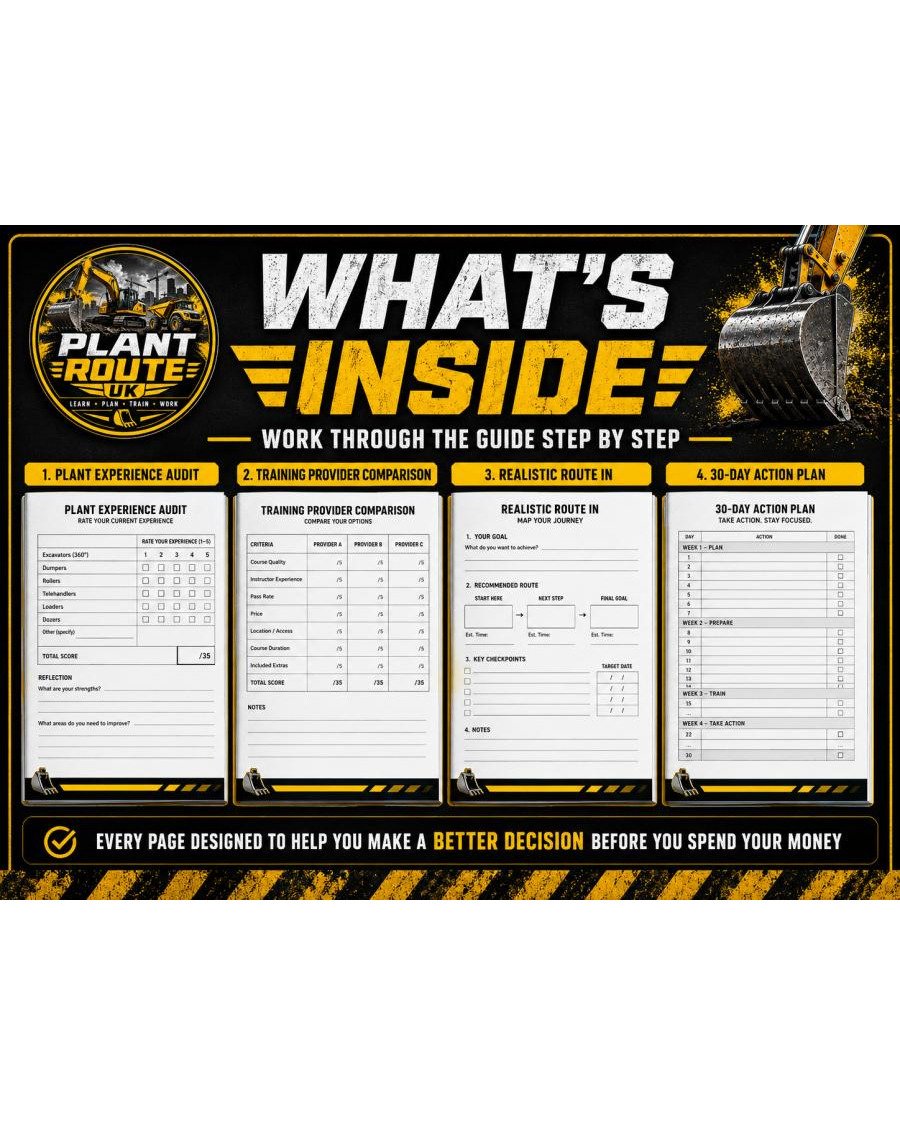
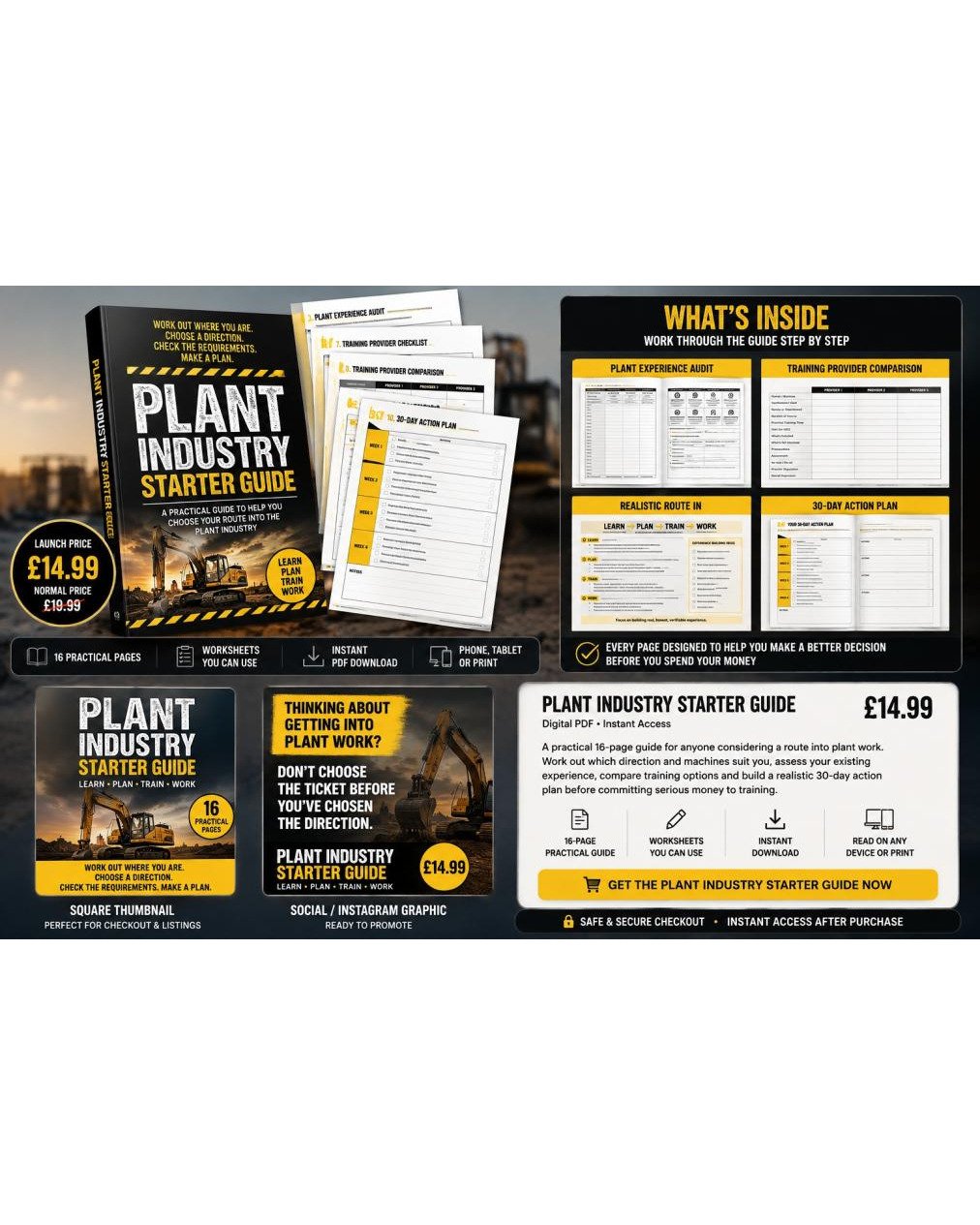
Get the Plant Industry Starter Guide →
The Plant Operator Apprenticeship Route for Under-25s and Career Changers
A plant operator apprenticeship is a structured, paid route combining site work with off-the-job training, ending in recognised competence.
For career changers in their thirties and forties, apprenticeships are harder to find and often pay less than a labouring job while you train.
Watch out: some training providers advertise "apprenticeship-style" courses that are not actual apprenticeships and carry no employer placement.
Entry-Level Construction Jobs With No Experience: Where the Openings Are
Entry-level construction jobs with no experience are found through three channels: direct applications to groundworks and civils contractors, labour agencies that supply site staff, and employer training schemes advertised through job boards. The agency route is fastest but least secure; direct applications take longer but tend to lead to real training.
Where to look:
- Groundworks and civil engineering contractors, who run plant constantly
- Housebuilders, who need dumpers and rollers on every plot
- Waste, recycling and quarry operators, where production operative roles sit alongside plant work
When you assess a vacancy, check whether "full training provided" means a funded ticket or just supervision. Ask directly: "Will you put me through a machine ticket, and which one?" A vague answer tells you a lot.
Realistic First-Year Pay, Deductions and Progression
Most job listings show a single hourly rate and leave you to work out what it means. Here is the realistic picture for a first-year trainee, including the parts listings leave out.
What first-year pay actually looks like
A trainee plant operator or site operative starts close to general construction labour rates, because you are not yet a competent operator. As a broad guide, entry-level UK site rates commonly sit around the National Living Wage up to a few pounds above it per hour, with London and the South East at the upper end. For detailed salary figures to check these pay expectations, see our plant operator salary expectations.
What moves the rate up quickly:
- Shift premiums, night shifts and weekend work usually carry a premium, often time-and-a-half or a fixed uplift
- Machine category, a ticketed 360 operator earns more than a dumper operator, and multi-machine operators earn more again
- Employment type, directly employed staff usually get holiday pay, sick pay and pension contributions; agency workers get a higher headline rate but fewer protections
Deductions to plan for
Income tax and National Insurance come off your pay through PAYE if you are employed (PAYE and payroll for employers: Introduction to PAYE). If you are paid through an umbrella company as a self-employed contractor, the fee structure matters, umbrella fees, employer's National Insurance and apprenticeship levy can all be deducted from the headline rate, so you receive less than the advertised figure.
PPE is usually provided by the employer on directly employed roles, but agency workers are sometimes asked to supply their own boots, gloves and high-visibility clothing. Budget for this in your first month.
Progression: where the money actually is
The operators who earn well are the ones who collect categories and prove reliability, not the ones who collect tickets fastest.
| Stage | Typical Role | What Changes |
|---|---|---|
| Year 1 | Trainee or labourer | Learning, low rate, ticket funded by employer |
| Year 2-3 | Ticketed operator | Higher rate, own machine category, shift premiums available |
| Year 4+ | Multi-machine operator | Several tickets, premium rates, choice of employers |
| Later | Supervisor or owner-operator | Responsibility or self-employment |
Apply for Your First Trainee Plant Operator Role
Applying well comes down to proving three things: you're safe, you're reliable, and you're genuinely interested in the machines. You don't need plant experience to demonstrate any of them.
On your CV, lead with your site-access card and any health and safety test passes.
Getting into plant operating is less about the machinery and more about clearing the right gates in the right order: site-access card, site job, employer-funded training, one machine ticket, then hours.
Frequently Asked Questions
Can you get plant operator jobs with no experience?
Yes, but usually through a trainee or labourer-to-operator route rather than a direct hire. Many employers take on groundworkers, labourers or production operatives and put them through on-the-job training and operator tickets once they have shown reliability and site awareness. The catch is that you often need a CSCS card and a site induction before you even start, so budget for those first. Realistic entry points include trainee plant operator vacancies, apprenticeship schemes and labouring roles with a clear path to machine operation.
What construction plant operator qualifications do employers actually ask for?
Most vacancies ask for a relevant operator card, usually CPCS or NPORS, for the specific machine you will run. A 360 excavator ticket is the most requested, followed by dumper and roller cards. You will also need a CSCS card for site access and a health and safety awareness course such as the CITB Site Safety Plus. Employers often list a full driving licence because sites are hard to reach by public transport. Qualifications are machine-specific, so check the job advert before booking any course.
Do you need a licence or operator card to work as a plant operator?
You need an operator card for the machine you intend to use, and most principal contractors will not let you on site without one. CPCS and NPORS are the two cards most widely recognised. The card proves you have been trained and assessed to a recognised standard. Some employers will fund the card for the right trainee, but many expect you to arrive with it already in hand, which is why choosing the right course matters before you spend money.
How do you become a trainee plant operator without wasting money on the wrong training?
Start by deciding which machine you want to operate, because each ticket is separate and costs add up. A 360 excavator card is the most transferable starting point for construction work. Check that the training provider is accredited to deliver CPCS or NPORS tests, and ask whether the course includes the test and card fee or charges them separately. Avoid booking three or four tickets before you have a job offer. One relevant ticket plus a CSCS card is enough to start applying for trainee plant operator roles.